

Events
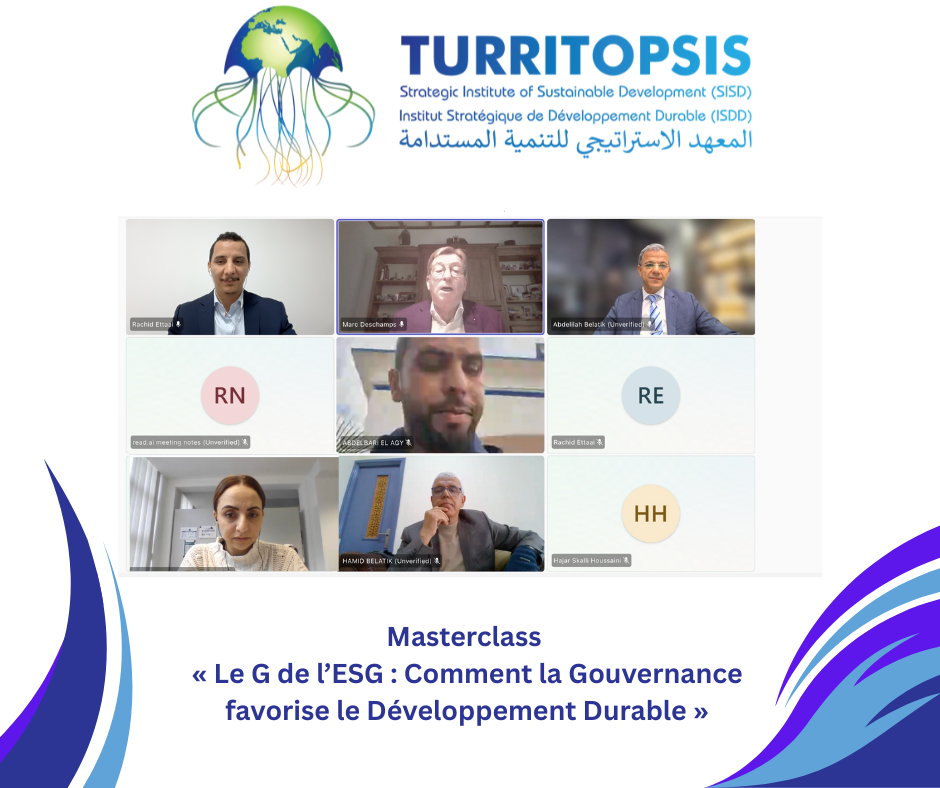
On November 20, 2025, Turritopsis successfully held an online masterclass titled “The G in ESG: How Governance Drives Sustainable Development.” Bringing together a diverse and engaged audience, the event confirmed the growing interest in governance as a strategic pillar of sustainable performance.
Led by Professor Marc Deschamps, a European governance expert, the session first revisited the essential link between sustainable development and governance, highlighting that governance represents both the structure that directs the legal entity and the force that frames the environmental and social dimensions of ESG. This approach was enriched by a look back at the origin of the concept of governance and its many forms, natural, codified, adapted or pragmatic, which must be considered according to the reality of organizations, particularly SMEs.
The masterclass also focused on governance actors and bodies, general assembly, board of directors, management bodies and specialized committees, and their interactions in strategic decision-making.
Professor Deschamps then detailed the logic of governance through the strategic path, linking mission, direction, decisions, implementation and interrelations, as well as the chain of risks and the control mechanisms needed to ensure sustainability, performance and complementarity.
A key moment was devoted to the six core criteria of the “G” in ESG: the structure and independence of the board of directors, ethics and the fight against corruption, shareholder rights and financial transparency, risk management and compliance, responsible executive compensation, and finally, the relationship with stakeholders.
The presentation showed how these criteria directly strengthen credibility, resilience and the creation of sustainable value. Finally, the cross-cutting integration of the “G” into the “E” and “S” dimensions was illustrated as a common thread running through any coherent ESG strategy.
Through this masterclass, Turritopsis reaffirms its commitment to promoting demanding, adapted and impact-oriented governance as an essential condition for a sustainable and high-performing transition. New sessions will continue this momentum in the coming months.